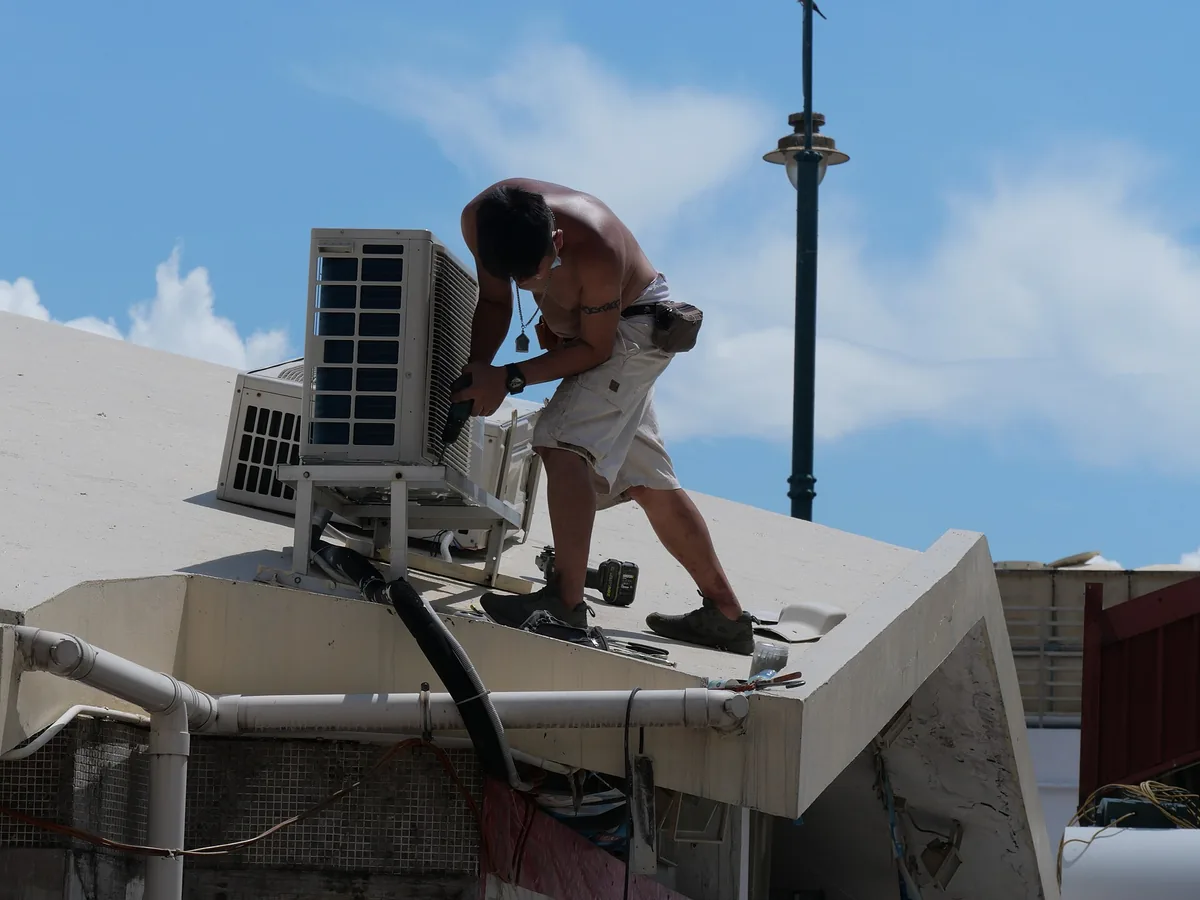
From July into September the monsoon swaps El Paso's cooling problem: not hotter, but humid. Refrigerated systems must dehumidify as they cool, condensate drains run at full capacity, and swamp coolers lose their physical margin on the wettest afternoons.
Problem: From July into September the monsoon swaps El Paso's cooling problem: not hotter, but humid. Refrigerated systems must dehumidify as they cool, condensate drains run at full capacity, and swamp coolers lose their physical margin on the wettest afternoons.
Solution: Prepare the drain before the season: cleared, trapped, treated, with its safety switch tested - monsoon condensate is gallons a day, and the clogged drain is the season's signature ceiling stain.
When to call: Judge your system by the humid-week test: a refrigerated system that holds temperature but leaves the house clammy is short-cycling or oversized for the moisture load - a diagnosis, not a fate.
El Paso has two summers. The first is the famous one - dry, bright, 105 degrees, made for shade and evaporation. The second arrives with the monsoon's first thunderstorm: the air thickens, the evenings stay warm and wet, and every cooling technology in the city is re-graded on a subject it was not primarily hired for - humidity. This guide is about passing that second summer.
The El Paso Angle
The water is the second force. El Paso's supply - drawn from the Rio Grande and the Hueco and Mesilla bolson aquifers - is very hard, loaded with the calcium and magnesium the desert geology hands it. That mineral load scales water heater tanks and elements, crusts faucet aerators and showerheads, spots every fixture, and quietly shortens the life of everything water touches.
What Humidity Changes, Physically
Comfort is temperature plus moisture: a house at 78 degrees and desert dryness feels crisp; the same house at 78 and monsoon humidity feels clammy, because skin cools by evaporation and humid air refuses the favor. Refrigerated air answers by wringing moisture out at the cold coil as it cools - which is why a correctly running system drips a steady stream at its condensate line in August and why the house feels cooler than the thermostat's number alone explains.
The moisture removal takes time the temperature does not: a system must run sustained cycles to dehumidify, and one that satisfies the thermostat in short bursts - oversized, short-cycling - can hold 75 degrees and still leave the house swampy. In monsoon weeks, run-time is dehumidification, and the sizing sins of spring installations are graded by the mugginess of the rooms they serve.
The Condensate Season
All that wrung moisture goes somewhere: the drain. A hard-working system in humid weeks produces gallons a day, through a line that has spent the dry months growing algae in its trickle. The clog arrives on schedule - the pan overflows, the safety switch (if fitted and working) kills the system on the hottest night, or without one, the ceiling below announces the failure in plaster.
The pre-monsoon drain service is therefore the season's least costly insurance: line cleared and flushed, trap correct, pan inspected, treatment placed, switch tested by actually lifting its float. Five minutes of the spring visit, aimed at the one AC failure that damages the house itself. Households that have mopped one ceiling stain never skip it again.
PROBLEM
→
SOLUTION
Swamp Coolers in Their Hard Weeks
For evaporative households the monsoon is the annual negotiation. On dry breaks between storm patterns the cooler still earns its keep; on the saturated afternoons its output approaches room temperature and moving the air is the only comfort left. The honest management: pads and water system kept at their best for the dry windows, windows strategy adjusted (less exhaust as output falls), and expectations set by the wet bulb rather than by June's memory.
Many El Paso households answer the season structurally - a mini-split for the bedrooms, a hybrid design, or the full conversion - because the monsoon is not an aberration but a quarter of the cooling year. This guide takes no side in that decision; it insists only that the decision be made from the physics: measure your home's humid-week comfort honestly for one season before letting anyone sell you either loyalty or equipment.
The House Itself in Humidity Weeks
The monsoon tests more than the AC: exhaust fans earn their keep (showers and cooking are moisture sources that suddenly matter), doors and windows stay shut during the humid afternoons however pleasant the storm-cooled air feels, and the attic's stored cardboard begins its quiet mildew negotiation. A small hygrometer in the living room turns the season from mood into data - indoor humidity in the comfortable band is visible, and so is the day it drifts out.
Houseplants, aquariums and drying laundry indoors all add to the moisture load the system must remove; in monsoon weeks the load budget is real. None of this is hardship - it is the seasonal awareness desert households already practice for heat, extended to humidity now that the desert has briefly become a swamp with mountains.
After the Season: The Debrief
September's end deserves ten minutes: How many clammy days? Which rooms? Did the drain behave? Did the cooler households in your family suffer or shrug? Written down, the answers size next year's decisions - a drain treatment schedule, a bedroom mini-split, a conversion design conversation held in the cheap months rather than in next August's regret.
The monsoon returns on schedule; the only variable is whether the household meets it with last year's notes or with last year's surprises. Desert living rewards the note-takers in every season - this one is simply the wettest of the lessons.
Myth vs Fact
The Myth
Turning the thermostat lower fixes monsoon clamminess.
VS
The Fact
Colder is not drier if the cycles stay short - an oversized system at a lower setpoint satisfies faster and dehumidifies even less, leaving a cold, damp house. The fix is sustained runtime and correct sizing, not a colder target.
The Related Service, In Depth
AC diagnosis is a three-body problem: electrical, refrigerant and airflow interact so completely that each condition imitates the others' symptoms. The capacitor's failure and the coil's fouling both arrive as 'warm air'; the low charge and the collapsed filter both arrive as ice. Instruments exist to cut through the imitation - the manifold, the meter, the thermometer - and the repair trade's core skill is refusing to conclude before they speak.
That is the service side of this guide's subject. When you are ready, the AC Repair page carries the process, the coverage by area and the number to call.
The Process, Step by Step
Service the condensate drain before July
Cleared, trapped, treated, switch tested - the monsoon's first appointment, made in the dry season.
Watch the drain line in the first storm week
A steady drip outside is health; its absence during heavy cooling is the clog warning.
Let the system run its long cycles
Avoid rapid thermostat swings; sustained runs are when dehumidification happens.
Grade your technology honestly for one season
Note the humid-week comfort by room. That diary is the conversion conversation's best evidence - whichever way it points.
Prevention Checklist
Keep a drain treatment habit - the pan and line are a garden you did not plant.
Know where your safety switch is and what its shutdown feels like (a dead system in August is often the switch doing its job).
Do not close supply registers to 'help' humidity; airflow is dehumidification's engine.
For cooler homes, keep pads at their best - the dry windows are worth winning fully.
After the season, have the drain re-checked; monsoon leaves the line loaded for winter growth.
Photograph your condensate line's exit point so the drip check takes ten seconds.
A Field Checklist for Your Own Home
Condensate drain serviced before July
Flushed, trapped, treated, switch float-tested.
Drain exit point known and checked
Steady storm-week drip verified by eye.
Thermostat strategy set for long cycles
No rapid swings; runtime is dehumidification.
Season diary kept by room
Clammy days counted - next year's evidence, this year's habit.
What the Paperwork Should Show
The monsoon also revises the house's relationship with its evaporative neighbors: shared walls, shared fences and shared humidity mean the season is faintly communal — drainage off roofs, standing water in yards feeding the mosquitoes that make evenings indoors a choice, the whole block's systems dripping in chorus. Managing your condensate and your yard water is citizenship as much as maintenance in the wet weeks.
For households with respiratory sensitivities, the monsoon is the season to be deliberate: humidity held in the comfortable band discourages the mold growth that standing moisture invites, and the system's drain-and-treatment discipline is respiratory infrastructure. The hygrometer on the shelf is a health instrument in August — watch it like one.
How a Professional Works This Problem
The monsoon professional's tell is drainage obsession: they speak of traps, vents and switch tests the way June's conversation speaks of refrigerant. A pre-season visit that spends real minutes on the drain is a visit calibrated to the season that actually damages houses.
Have the technician demonstrate the safety switch by lifting its float during the pre-season visit - a tested switch is protection, an untested one is a hope with a wire.
The Bottom Line
The second El Paso summer is shorter than the first and stranger, and it grades different virtues: drainage, runtime, sealed doors and honest measurement. Prepare the drain, let the system run long, keep the diary - and the monsoon becomes the season you watch from a dry, cool room while the desert briefly pretends to be a jungle.
El Paso summers do not test AC systems gradually; the first 105-degree week applies full load to equipment that sat in dust all spring. The systems that fail then were almost all findable in April - dirty coils, drifting capacitors, low charge, clogged drains.
Mini-splits deliver zoned refrigerated cooling and efficient heating without ducts - ideal for El Paso's casitas, additions, converted garages, adobe homes without duct paths, and bedrooms that never matched the house.
Why does my house feel clammy even though the AC holds temperature?
Short cycles. Dehumidification needs sustained coil time; a system that reaches the setpoint quickly and stops - usually oversized for the sensible load - leaves the moisture behind. Fixes range from airflow and charge corrections to fan settings that extend cycles, and at replacement time, right-sizing or two-stage equipment sized for the latent load as well.
My AC shut off entirely during a humid week in El Paso. Why?
The leading suspect is the condensate safety switch: a clogged drain filled the pan, the float lifted, and the switch killed the system to save your ceiling. It is the one shutdown that means the protection worked. The service call clears the drain and treats it; the system usually returns the same visit.
Can a swamp cooler be helped through the monsoon at all?
Marginally: pristine pads and full water delivery win the dry windows completely, and exhaust strategy matters more as output falls. But its ceiling is the wet bulb, and on saturated afternoons no service raises it. Households for whom those weeks are unbearable are conversion candidates; households who tolerate them own the least costly cooling in the city for the other three quarters.
Is mold a monsoon risk inside my AC system?
The coil and drain pan are wet all season by design, which is why drainage and treatment are disciplines: a draining, treated pan is a hostile place for growth; a stagnant one is a garden. Musty startup smells in August are the audit arriving by nose - the spring drain service and mid-season treatment are the answers.
Please note: El Paso Home Services is an independent directory and referral service, not a plumbing or HVAC contractor. The professionals reachable through this site are independent businesses; any agreement for work is between you and the professional you engage. Service information on this site is general educational material - the scope of any real work is set by an on-site inspection.
A Burst Pipe, a Backed-Up Drain or an AC That Quit in July?
One call connects you with a local home-services professional serving El Paso - plumbing and cooling help, matched to your part of the city.