El Paso Plumbing

Water Heater Repair in El Paso, TX

Water heater repair in El Paso - no hot water, rumbling tanks, leaking valves, dead elements and pilot problems - diagnosed against the city's brutal hard water.

Wind and dust run third. Spring is wind season, when dust storms roll off the desert and load every AC condenser coil, cooler pad and filter in the city. Then the monsoon arrives from July into September, humidity climbs, afternoon storms flood arroyos and low streets, and swamp coolers that worked in June suddenly cannot keep up.

And winter has teeth here, whatever the postcards say. Desert nights drop below freezing for stretches every year, and hard cold snaps - El Pasoans still measure them against the February 2011 freeze - burst exposed pipes across whole neighborhoods in a single night. Plumbing and cooling in this city are built, or should be, for all four of those forces at once.

Signs You Need Water Heater Repair

No hot water, or hot water that runs out fast

A dead element, a failed thermostat, a pilot problem - or a tank so full of sediment that its working capacity has shrunk by gallons.

Popping, rumbling or crackling from the tank

Sediment on the tank floor traps water that boils and pops as it escapes. The noise is wasted energy and a tank wearing out early.

Rusty or discolored hot water only

When only the hot side runs rusty, the tank is the source - anode rod spent, tank steel starting to corrode. This is the clock ticking out loud.

Water pooling at the base or a dripping T&P valve

Valve drips can be pressure or temperature problems; water at the base seam usually means the tank itself. One is a repair, the other is a replacement conversation.

Pilot light that will not stay lit

Thermocouple, gas control or venting - gas heaters have their own failure list, and it starts with parts that are genuinely replaceable.

Hot water that smells like rotten eggs

Bacteria feeding on the anode rod's byproducts in a warm tank - common in El Paso's water chemistry, and usually fixable without replacing the tank.

Why Water Heater Repair Is a Standing Job in El Paso

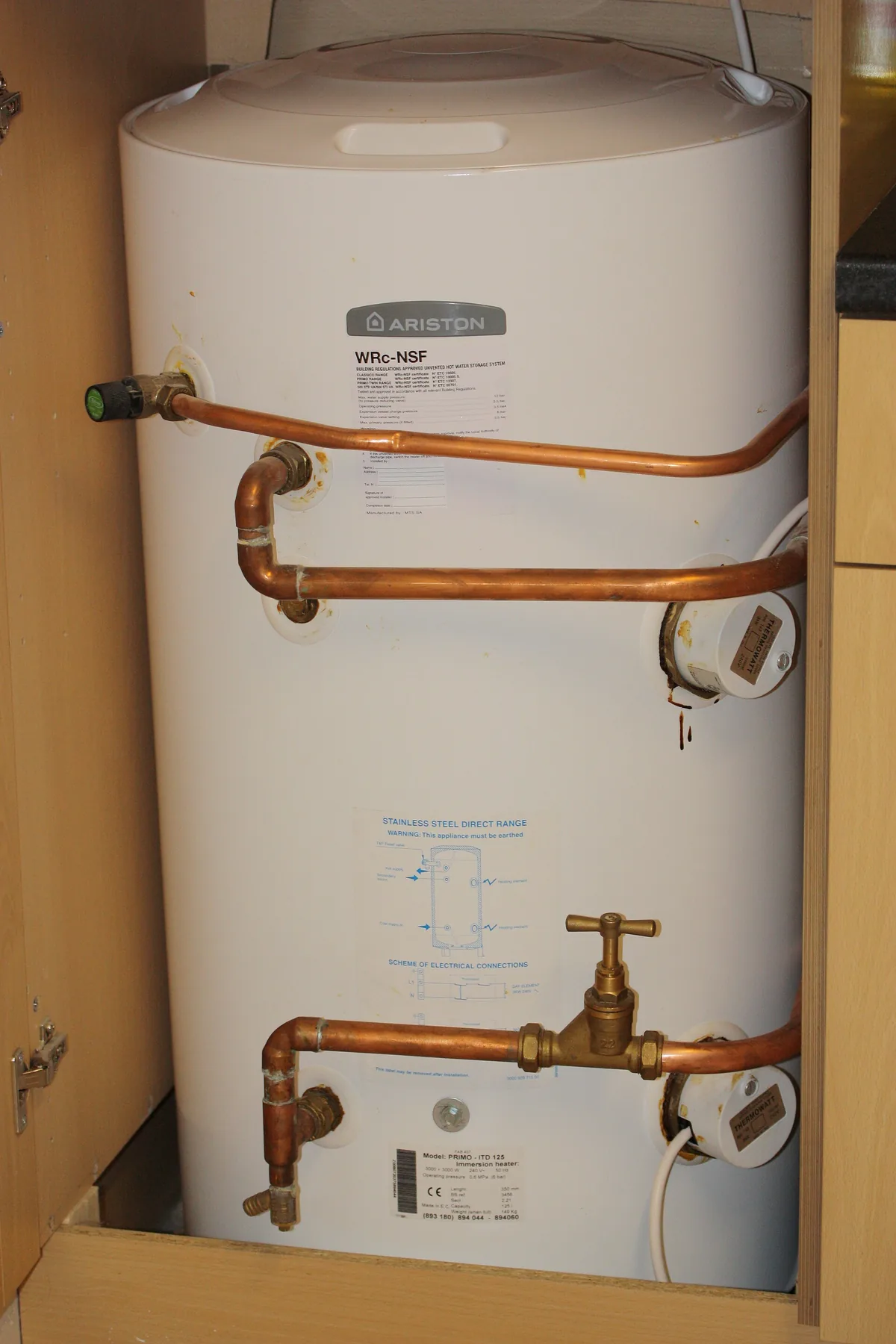
Sediment is the headline act. Every gallon of El Paso water carries dissolved calcium and magnesium; heat them, and the minerals precipitate out and settle. In an unflushed tank the sediment bed grows inches deep - insulating the water from the burner or elements, overheating the tank floor, and stealing capacity gallon by gallon. The popping sounds, the long recovery times and the early tank deaths all trace back to that one layer.

The anode rod is the quiet casualty. The rod exists to corrode in the tank's place, and in aggressive mineral water it is consumed fast - sometimes in two or three years. Once it is gone, the tank itself becomes the anode, and rust-through becomes a matter of time. Rod condition, checked at a service visit, is the single best predictor of a tank's remaining life.

Elements and valves wear the same water's other face: scale coats electric elements until they overheat and burn out, and crusts temperature-pressure valves and drain valves until they weep. El Paso heaters rarely die of one dramatic failure; they accumulate mineral damage until one of its symptoms finally makes the call.

Water Heater Repair Through the El Paso Year

Summer is the proving season. Weeks of 100-degree afternoons run air conditioners near-continuously, cold water lines sweat in hot attics, and water heaters work against the highest inlet temperatures of the year. Then the monsoon folds humidity into the heat: refrigerated air must suddenly dehumidify as well as cool, and swamp coolers lose their edge entirely on the humid afternoons.

Fall is the repair window. The monsoon breaks, the heat lets go, and the weather turns calm and dry - the right weeks to fix what the summer exposed, flush the water heater before the holidays load it, and swap cooler systems over before the first freeze night finds water still sitting in their lines.

El Paso winters are bright days and freezing nights. The danger hour is the desert dawn, when exposed and under-insulated pipes - hose bibs, garage runs, attic lines, cooler supply lines - reach their coldest. Winter work here is freeze protection and heating: furnaces and heat pumps that sat idle since March get their first real calls on the coldest nights of the year.

Water Heater Repair in Depth

A water heater's symptoms are a mineral diary. The rumble dates the sediment; the rusty draw dates the anode's death; the lukewarm shower dates the element's scale coat. Repairing the symptom without reading the diary - swapping an element into a tank full of sediment, replacing a valve on a rusting vessel - spends money inside a story that continues unchanged. The tank's condition, read honestly, is the repair decision.

That is why the repair-versus-replace verdict is this trade's signature judgment. It weighs the tank's integrity and age against the failed part's cost and the water's demonstrated aggression - and it can land either way with integrity. A five-year-old tank with a dead element is a repair all day. A twelve-year-old tank with its third failure is a replacement wearing a repair's clothes, and the honest technician says so with the evidence on the table.

Choosing the Right Help

The repair's quality is the verdict's quality. Choose the technician who tests the failure chain and grades the tank before recommending - and who can defend a repair on an old tank or a replacement on a young one with the same evidence. In hard-water country, insist the flush is part of the conversation; a repair that ignores sediment is half a repair.

The Climate Behind It

El Paso sits in the Chihuahuan Desert at roughly 3,700 feet, and the desert sets the terms for every pipe and compressor in the city: summer afternoons that pass 100 degrees for weeks, sun that bakes rooftops and outdoor units all day, and air dry enough that evaporative cooling works - most of the year. Home systems here do not age the way they age in humid or mild cities.

The water is the second force. El Paso's supply - drawn from the Rio Grande and the Hueco and Mesilla bolson aquifers - is very hard, loaded with the calcium and magnesium the desert geology hands it. That mineral load scales water heater tanks and elements, crusts faucet aerators and showerheads, spots every fixture, and quietly shortens the life of everything water touches.

How Water Heater Repair Works

Test before touching

Elements, thermostats, gas controls and tank condition are tested in sequence - the failed part is named by evidence, not by the most common guess.

Judge the tank honestly

Age, anode condition, rust signs and sediment depth decide whether repair is a fix or a postponement. You hear which, and why.

Repair with the water in mind

Elements, thermocouples, valves and controls are replaced as needed - and the sediment that caused the wear is flushed as part of the same visit.

Set the maintenance that prevents the repeat

A flush schedule and an anode-check interval fitted to El Paso water - the difference between a repair and a recurrence.

Doing It Yourself vs a Professional

The DIY Route

  • Replacing elements on a scaled tank without flushing it installs new parts into the same hostile conditions
  • Relighting a pilot repeatedly without finding why it dies can mask a venting or gas-control fault
  • Cranking the thermostat to compensate for sediment just bakes the sediment harder and scalds at the tap
VS

The Professional Route

  • Tests the failure chain - power, elements, controls, tank - before replacing anything
  • Gives the repair-vs-replace verdict from tank evidence, not from a sales target
  • Flushes the sediment cause out with the repair, so the fix is not a countdown to the same call

Keep It From Coming Back

A water heater in this water does not need luck; it needs its sediment moved and its anode checked. The rhythm below is measured in minutes per year and repaid in years per tank.

  • Flush a few gallons - or a full flush yearly - to keep sediment from baking in.
  • Have the anode rod checked around year three in El Paso water, not year six.
  • Keep the temperature at 120 degrees; hotter settings accelerate scale and wear.
  • Watch for the first rumble - it is the least costly moment to act.
  • Keep the area around the heater clear so leaks are visible early.
  • Consider softening or conditioning where heaters and fixtures scale fast.
Water Heater Repair in the Valley Communities

The communities around El Paso share its heat and its water - with their own twists of wells, septic systems, altitude and age.

Water Heater Repair in Sunland Park

Sunland Park is the New Mexico city pressed against El Paso's west flank - home to the Sunland Park Racetrack and Casino, neighborhoods under Mount Cristo Rey, and streets that cross the state line without changing their character. Its residents shop, work and live on both sides of the line.

Water Heater Repair in Fort Bliss Area

The Fort Bliss area wraps around one of the Army's largest installations - the neighborhoods off-post along US-54 and Airport Road where soldiers and their families rent and buy, plus the commercial strips that serve the post. Turnover is a way of life here; rental properties cycle tenants every few years.

Water Heater Repair in Anthony

Anthony straddles the Texas-New Mexico line at the top of the Upper Valley - a small farming town of orchards, dairies and quiet streets where the state line runs down the middle of town. It is the valley's rural bookend, twenty minutes and a world away from downtown El Paso.

Water Heater Repair in Fabens

Fabens is the valley's downriver farming town - cotton and chile fields along the Rio Grande, a main street of older storefronts, and neighborhoods where families have farmed the same valley floor for generations. It is the last El Paso County community before the river road heads toward Tornillo.

Where Water Heater Repair Is Needed Most

On the east side and up against the mountain - Eastside, Far East El Paso, Westside and Northeast, Central - the housing runs from fast-built subdivisions to base-adjacent rentals, and water heater repair follows the construction: new systems aging in hard water at record pace, warranty-era fittings reaching their first failures together, and summer loads that test every installation shortcut.

Across the center, the west and the valleys - Upper Valley, Lower Valley, Mission Valley and Horizon City, Socorro, Canutillo - sit the city's oldest homes, its historic districts and its foothills customs, which together make this the steadiest water heater repair territory in the city.

Beyond the city line, the same work runs in Sunland Park, Fort Bliss Area, Anthony, Fabens - mission towns, desert subdivisions and valley communities where wells, septic systems and long service runs add their own chapters. Every one of these area pages carries the local detail for water heater repair in that community.

Coverage, In Full

Water Heater Repair runs across the whole service map: the Eastside and Far East El Paso; the Westside and the Upper Valley; the Northeast and the Fort Bliss area; Central El Paso and Downtown; the Lower Valley and Mission Valley; and beyond the city in Horizon City, Socorro, Canutillo, Sunland Park, Anthony and Fabens. One call covers all of it - the local pages above carry the detail for each. If your street is not named here, call anyway: routes grow with demand, and most El Paso addresses are already within reach of a scheduled run.

From the El Paso Home Guides

Freeze Protection for El Paso Pipes: The Desert Cold-Snap Playbook

El Paso's clear desert nights drop below freezing in fast, deep swings, and the pipes that burst are predictable: hose bibs, garage and laundry runs on outside walls, attic lines, and undrained swamp cooler supply lines - the 2011 freeze wrote the lesson citywide. Prevention is a fall hour: insulate the exposed runs, drain the cooler line, cover the bibs, learn the shutoff, and drip-and-open-cabinets on the hardest nights. Every item targets a line the cold reaches first.

Read the Guide

Slab Leaks in El Paso: Signs, Causes and the Repair Options Explained

Most El Paso homes sit on concrete slabs with water lines beneath them, on soils that move and with water that corrodes - so slab leaks are a known local failure with known signs: warm floors, a running meter, a doubling water bill. Pinpoint acoustic detection comes first; then the fix is chosen from the system's age and the leak's company: a spot repair for the isolated failure, a reroute for the tired line, a repipe for the pattern.

Read the Guide

El Paso Hard Water: What It Does to Your Home and What Actually Works

El Paso's water is among the hardest municipal supplies in Texas - dissolved calcium and magnesium from desert aquifers precipitate onto everything hot or evaporating, filling water heaters with sediment and crusting every fixture. True softening removes the minerals and stops the damage cycle house-wide; conditioning changes scale's behavior without removing it; fixture-level cleaning manages symptoms. The right answer follows what the water is costing your specific home.

Read the Guide

Water Heater Repair Questions

What are the most common water heater repairs in El Paso?

Burned-out elements (scale-coated until they fail), worn thermocouples and gas controls, weeping T&P and drain valves, and sediment flushes for rumbling tanks - nearly all of them mineral-water stories. The repair list in this city is short because the cause list is shorter: hard water, working constantly.

Can a leaking water heater be repaired?

It depends where the leak is. Valve and fitting leaks - yes, routinely. A tank leaking at its body or base seam - no; the vessel itself has failed and replacement is the only honest answer. The visit's first job is telling those two apart with certainty.

Why does my hot water run out faster than it used to?

Usually capacity loss: sediment occupies gallons of the tank, or one of two elements has died and the tank heats at half strength. Both are diagnosable in minutes and one of them is a repair; a flush and an element restore what the household remembers.

What affects the cost of water heater repair in El Paso?

The failed component, the heater type (gas or electric, tank size), access in its closet or garage, and the tank's overall condition - a repair that also needs a flush and an anode costs differently than a thermostat swap. The number follows the diagnosis.

Why is my water heater in El Paso making popping noises?

Sediment. A layer of baked mineral on the tank floor traps water underneath; the water boils, and the pops and rumbles are it bursting through the sediment. It means the heater is working harder, heating slower and wearing faster - a flush now may restore it; years of it shortens the tank's life.

How do I know if my El Paso water heater can be repaired or must be replaced?

Tank integrity decides. Failed elements, thermostats, thermocouples, valves and controls are all repairs - on a sound tank. Rust at the base seam, rusty hot water from a spent anode era, or a leaking tank body are replacement territory. Age sharpens the judgment: the same repair means more on a five-year-old tank than a twelve-year-old one.

How long should a water heater last in El Paso?

Less than the national story. Unmaintained tanks in this water commonly give up years earlier than the same model in a soft-water city; flushed tanks with anode rods replaced on schedule run noticeably longer. The range is wide because the maintenance, not the brand, is the main variable.

Is rusty hot water in El Paso dangerous?

It is a symptom more than a hazard - iron from a corroding tank or a consumed anode rod. But it is also the tank's clearest warning: once the steel itself is rusting, the path ends at a leak. Treat rusty hot water as a prompt appointment, not a wait-and-see.

Please note: El Paso Home Services is an independent directory and referral service, not a plumbing or HVAC contractor. The professionals reachable through this site are independent businesses; any agreement for work is between you and the professional you engage. Service information on this site is general educational material - the scope of any real work is set by an on-site inspection.

A Burst Pipe, a Backed-Up Drain or an AC That Quit in July?

One call connects you with a local home-services professional serving El Paso - plumbing and cooling help, matched to your part of the city.

📞 Call Now